
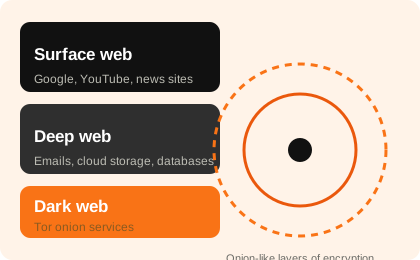
Deep Web vs Dark Web: What's the Difference?
"Deep web" and "dark web" are used interchangeably in headlines, but they describe two very different things. The moment you check your email or pay a bill online, you are using the deep web. The dark web is a separate, much smaller world that requires special software. This guide clears up the confusion once and for all.
What is the deep web?
The deep web is everything online that search engines like Google, Bing, or DuckDuckGo cannot index. That sounds mysterious, but it describes almost everything you actually use on a normal day:
- Your email inbox (Gmail, Outlook, Proton Mail)
- Online banking and payment portals
- Private social media profiles and direct messages
- Cloud storage files (Google Drive, Dropbox, OneDrive)
- Corporate intranets, medical records, legal databases
- University libraries, streaming paywalls, member areas
Why aren't these indexed? Because they sit behind login screens, paywalls, or robots.txt restrictions. Search engines simply cannot see or should not see them. By most estimates, the deep web makes up the overwhelming majority of all online content — while the surface web is only a few percent of it. In short: the deep web is not creepy, it is the internet you live in.
What is the dark web?
The dark web is a small subsection of the deep web that is additionally hidden and unreachable through normal browsers. Sites there use onion addresses (like something.onion) and are only accessible through anonymity networks such as Tor. Both visitors and site operators hide their IP addresses from each other.
The dark web has existed since the early 2000s and is far smaller than most people imagine — typically just tens of thousands of active onion sites at any time. It hosts legitimate forums, encrypted messaging, whistleblower drop boxes, and also illegal markets that law enforcement continuously dismantles. For the full picture, start with our plain-English introduction: what is the dark web?
Deep web vs dark web: the key differences
| Deep web | Dark web | |
|---|---|---|
| Access | Normal browser + login or URL | Tor browser (or similar) only |
| Searchable | Not indexed by engines | Not indexed; .onion addresses only |
| Anonymity | Optional; usually accounts | Built in for both users and sites |
| Size | The largest part of the internet | A tiny fraction of the deep web |
| Typical users | Everyone with an email or bank account | Journalists, activists, researchers, privacy users |
| Legality | Completely normal, daily use | Legal to browse; illegal activity is prosecuted |
Why the confusion is dangerous
Confusing the two terms leads to bad decisions. Some people believe using "the deep web" is risky and avoid privacy tools altogether. Others believe the dark web is just "a hidden internet" where everything is legal because it is hard to find. Both beliefs are wrong — and both can get people in trouble.
The most practical danger is falling for dark web scams: fake marketplaces, phishing "onion" sites that look like banking pages, and sellers who take money and vanish. If you read nothing else on this site, read dark web scams: how to spot and avoid them.
How to think about privacy on both layers
Your deep web presence (email, banking, cloud) is protected by companies you trust — and trust can be betrayed. Data breaches expose deep web accounts constantly, which is exactly why credential monitoring exists. Your dark web presence, if you ever create one, is protected only by your own discipline.
- Use unique passwords and two-factor authentication for every important deep web account.
- Check whether your email appears in known breach lists using services like Have I Been Pwned.
- If you value privacy even in everyday browsing, learn what a VPN can and cannot do.
- If you ever explore the dark web, read the Tor browser safety guide first.
Frequently asked questions
Is checking my email "deep web" activity?
Yes. Any page behind a login, including webmail, is technically part of the deep web. It is completely normal.
How big is the dark web compared to the deep web?
Vanishingly small. The deep web dwarfs the surface web; the dark web is a tiny fraction even of the deep web — usually measured in tens of thousands of active sites.
Can search engines find dark web pages?
No. Sites on the dark web use .onion addresses that only resolve inside anonymity networks like Tor. Regular search engines, including DuckDuckGo's service, only index surface web pages.
Further reading: Deep web (Wikipedia) · Dark web (Wikipedia) · Tor Project

